in production2024–presentMy own product · iOS, Android and web
ServiceIn
Tip splitting for restaurants: tips go in as the night runs, the day closes in three steps, and every waiter sees their own balance.
The screens come from the new versions of the web panel and the app, built with Claude Code and now in testing, running on their demo data: an invented restaurant and team. Their text was translated from Spanish as each screenshot was taken, and nothing on screen was redrawn. ServiceIn runs in Spanish.
- “From the tip jar to each waiter.” On mint, with the route: tips, close the day, split, each waiter, payout.
- “Every tip, as it comes in.” The web panel’s Today’s tips page for Monday, October 19: today’s tip pool of $ 18,450, with 2300 typed in the amount field next to Add and Edit total.
- “Who worked, and how many points.” Today’s split by points in the web panel: Camila González, Diego Pereira, Florencia López, Lucía Fernández and Martín Rodríguez are checked and Joaquín Sosa is not. With 1, 1.5, 0.5, 1 and 1 points they get $ 4,150, $ 6,225, $ 2,075, $ 4,150 and $ 4,150 of the $ 20,750 pool, at $ 4,150.00 a point.
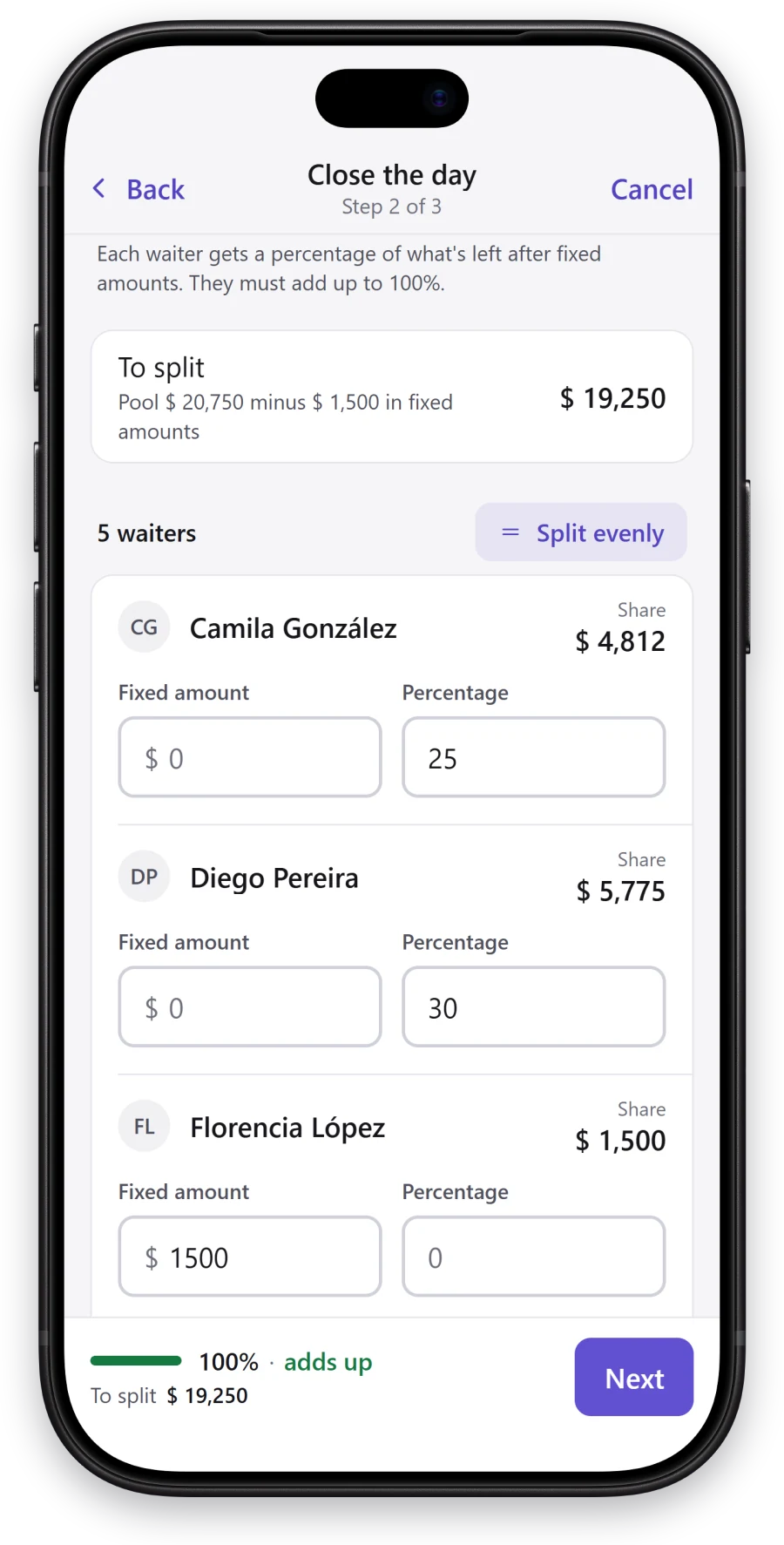
- “Or a percentage, after fixed amounts.” On an iPhone, the restaurant’s app splits by percentage, step 2 of 3: Florencia López has a fixed $ 1,500, which comes off the $ 20,750 pool first and leaves $ 19,250 to split; Camila González’s 25% comes to $ 4,812 and Diego Pereira’s 30% to $ 5,775, and the bar reads 100%, adds up.
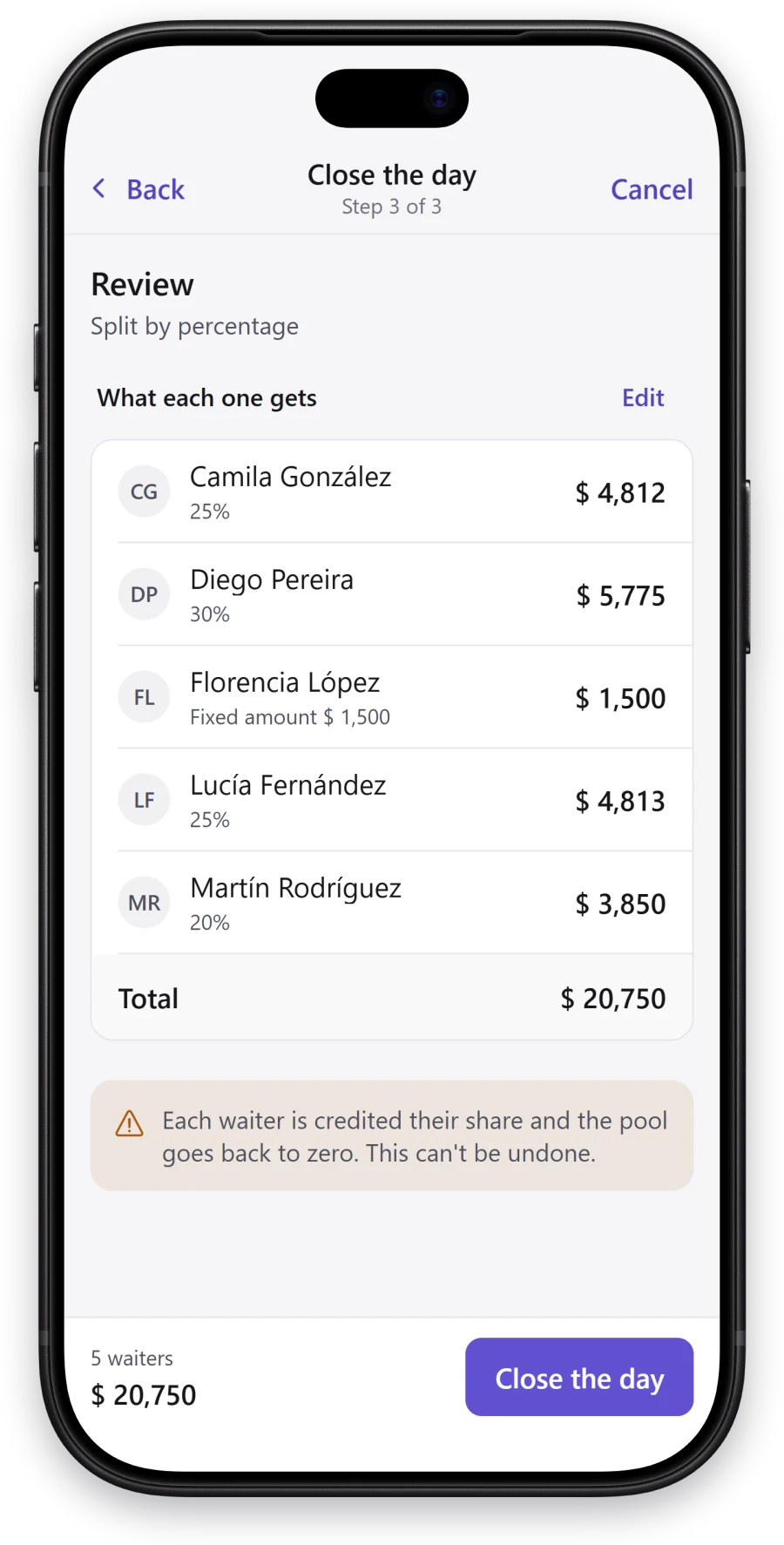
- “Exact to the peso.” The review, step 3 of 3, on the same iPhone: Camila González $ 4,812 (25%), Diego Pereira $ 5,775 (30%), Florencia López $ 1,500 (fixed amount), Lucía Fernández $ 4,813 (25%) and Martín Rodríguez $ 3,850 (20%), for a total of $ 20,750.
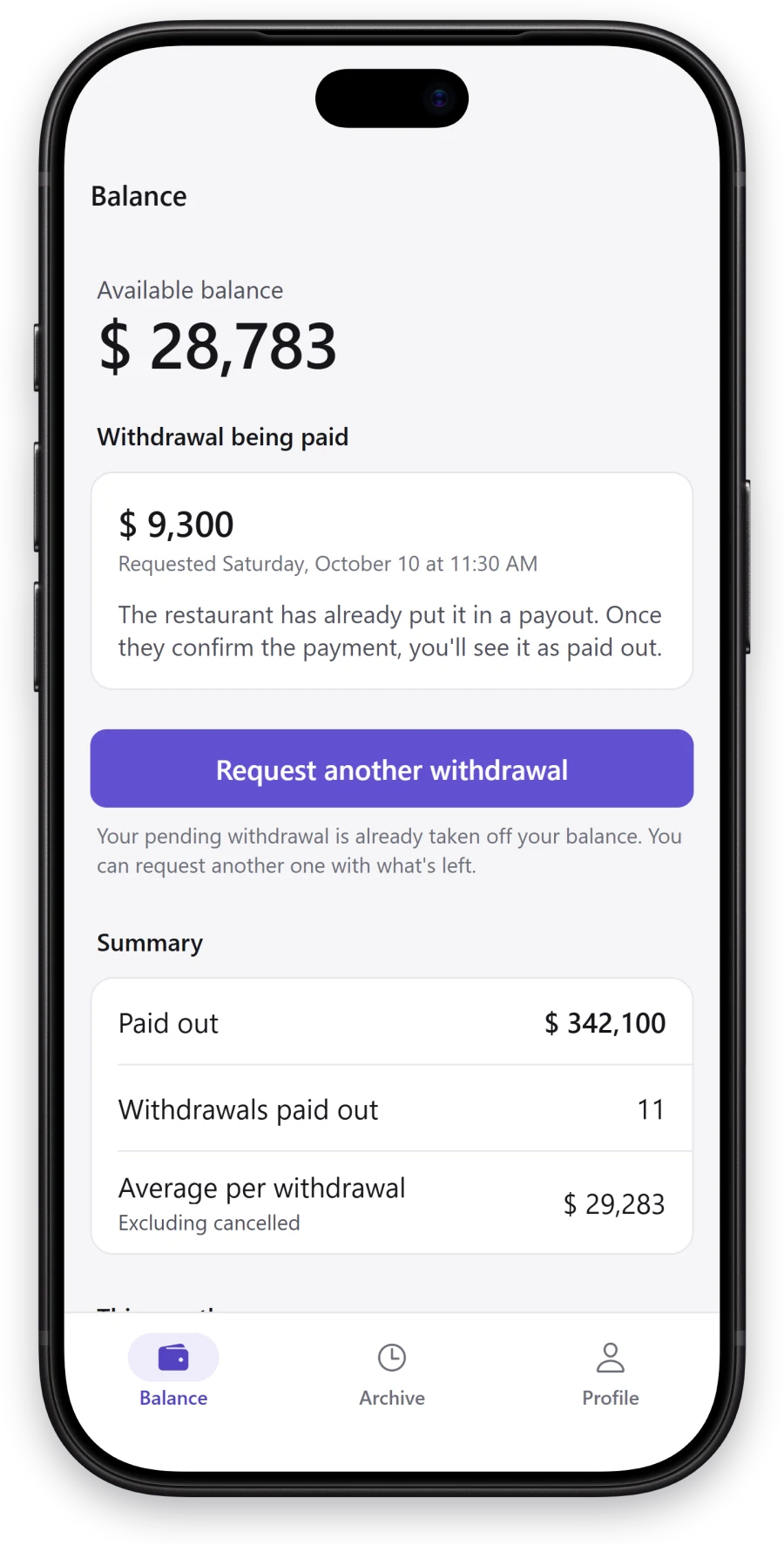
- “Each waiter sees their own.” The waiter’s app on the iPhone, on its Balance tab: $ 28,783 available, and a $ 9,300 withdrawal being paid, requested Saturday, October 10, that the restaurant has already put in a payout.
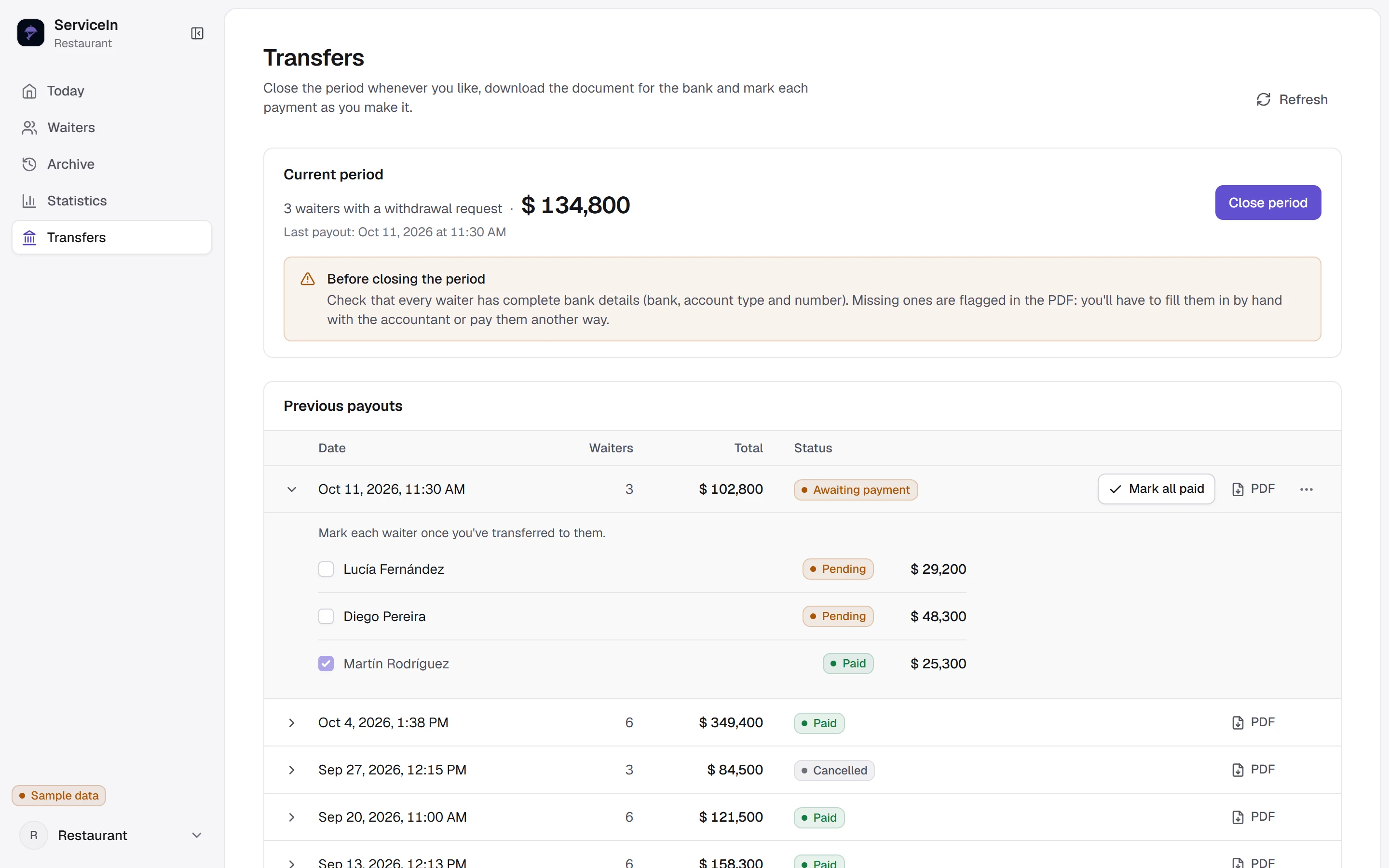
- “Payouts in batches, with a bank PDF.” Back in the web panel, on Transfers, the payout of Oct 11, 2026, 11:30 AM is open: $ 102,800 for 3 waiters, awaiting payment, with Lucía Fernández ($ 29,200) and Diego Pereira ($ 48,300) pending and Martín Rodríguez ($ 25,300) paid, next to the Mark all paid and PDF buttons.
- It closes on “ServiceIn,” in production since 2024, on iOS, Android and web.
The web screens are captures of the real web panel’s new version, and the phone screens are captures of the real app, set in an iPhone mockup; both run on demo data, and their text was translated from Spanish as each one was taken.
From the tip jar to each waiter.
From the tip jar to each waiter.
A restaurant collects tips all night and splits them among whoever worked, by percentage or by points. ServiceIn turns that end-of-night math into three steps, on the web panel or a phone.
Tips go in as they come
Each tip is added to the day’s pool from the web panel or the app, cash and card alike. The pool is a running total, so a mistake is one Edit total away.
ServiceIn web panel · demo data · translated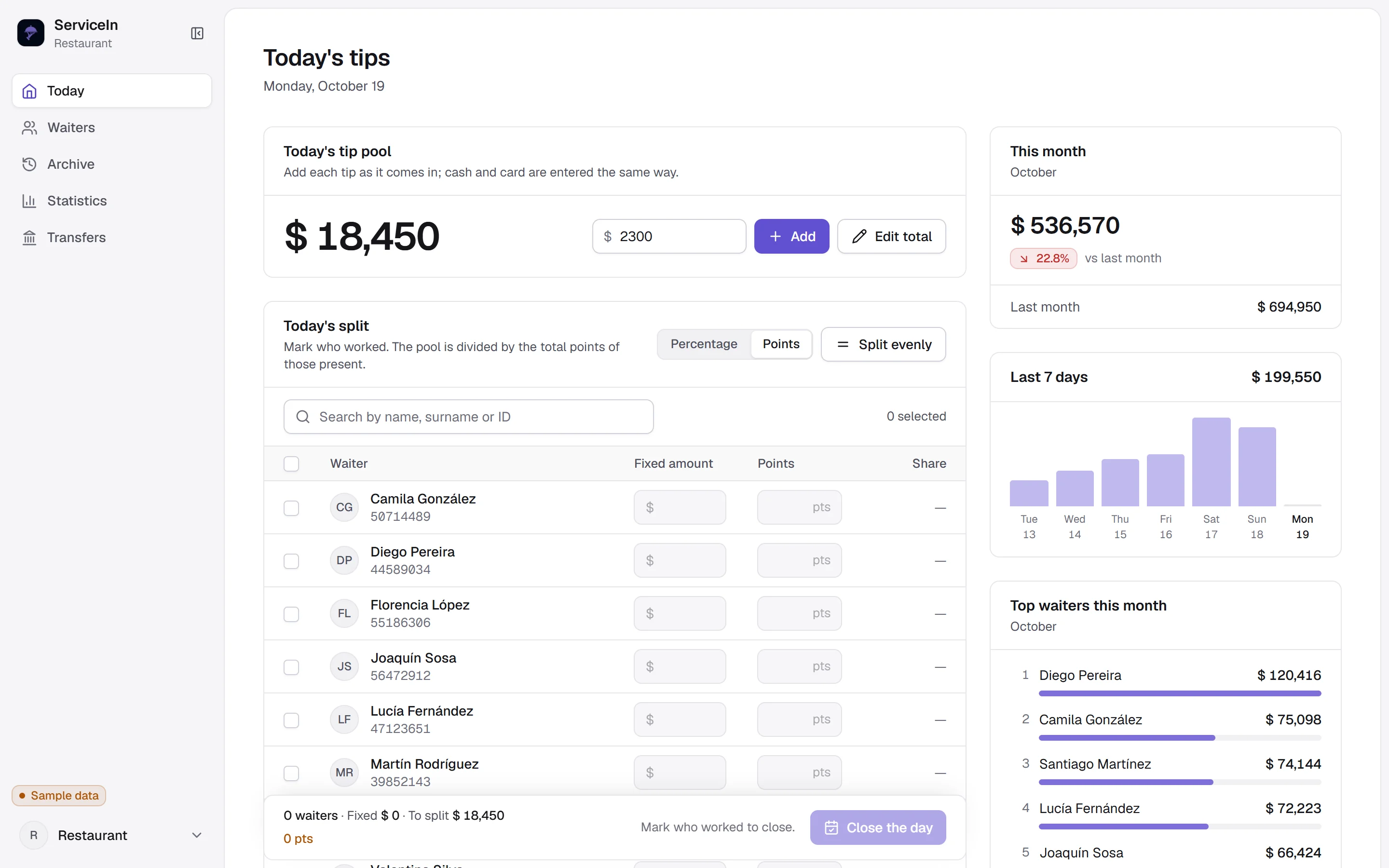
screenshot of the real web panel, with demo data, translated from Spanish Who worked, and how many points
Closing starts with the people: the restaurant marks who was on shift, and only they share the pool. By points, one point is worth the pool divided by the points of those present, and each waiter’s points come from their file.
ServiceIn web panel · demo data · translated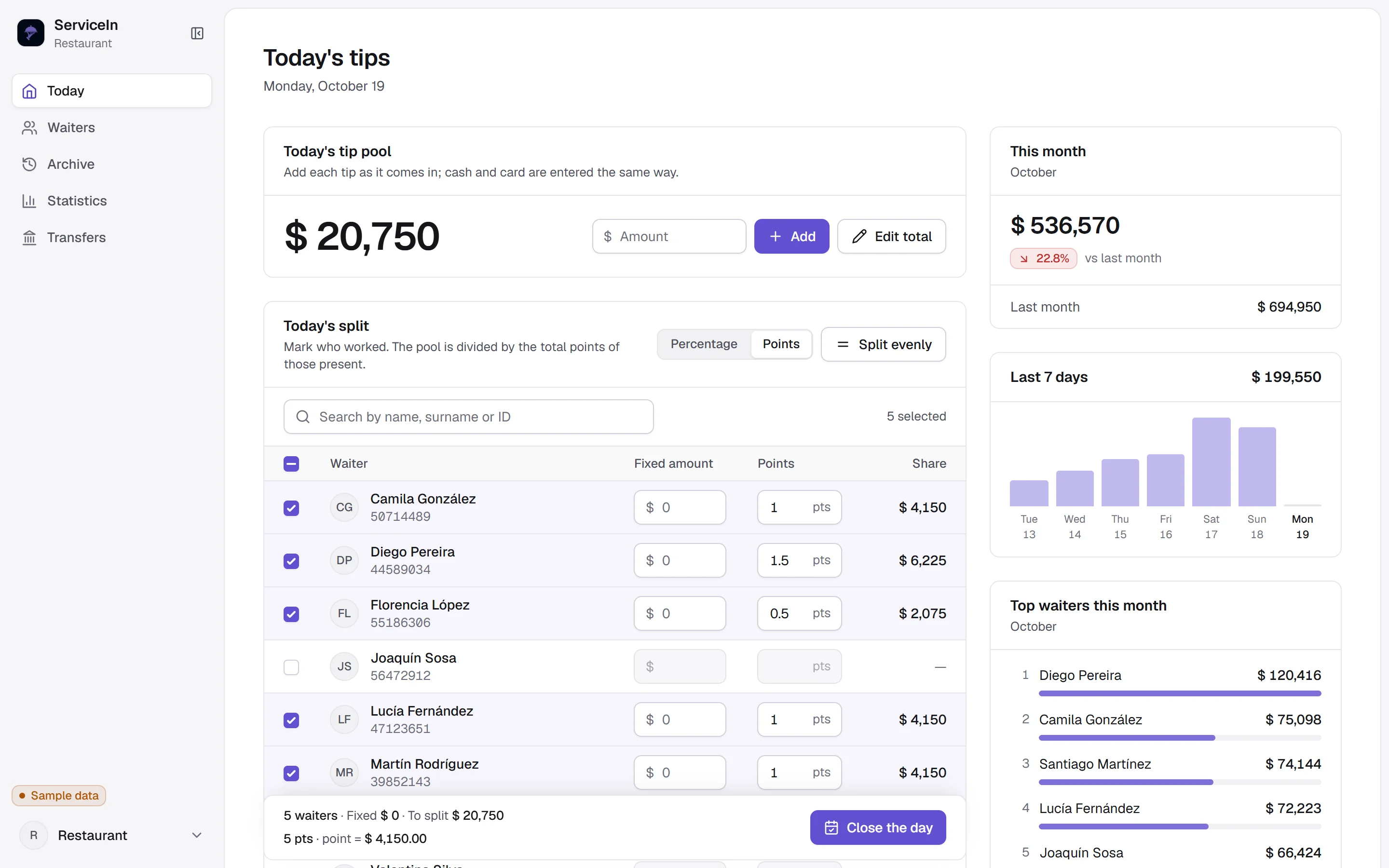
screenshot of the real web panel, with demo data, translated from Spanish Or a percentage, after fixed amounts
The same closing runs in the app. Fixed amounts are paid first, and the rest goes by percentage, which has to add up to 100%.
screenshot of the real app on an iPhone, with demo data, translated from Spanish Review, then close
The last step shows what each one gets and warns that it can’t be undone. Closing credits every waiter at once and sends each of them a push notification with their amount.
screenshot of the real app on an iPhone, with demo data, translated from Spanish Each waiter sees their own
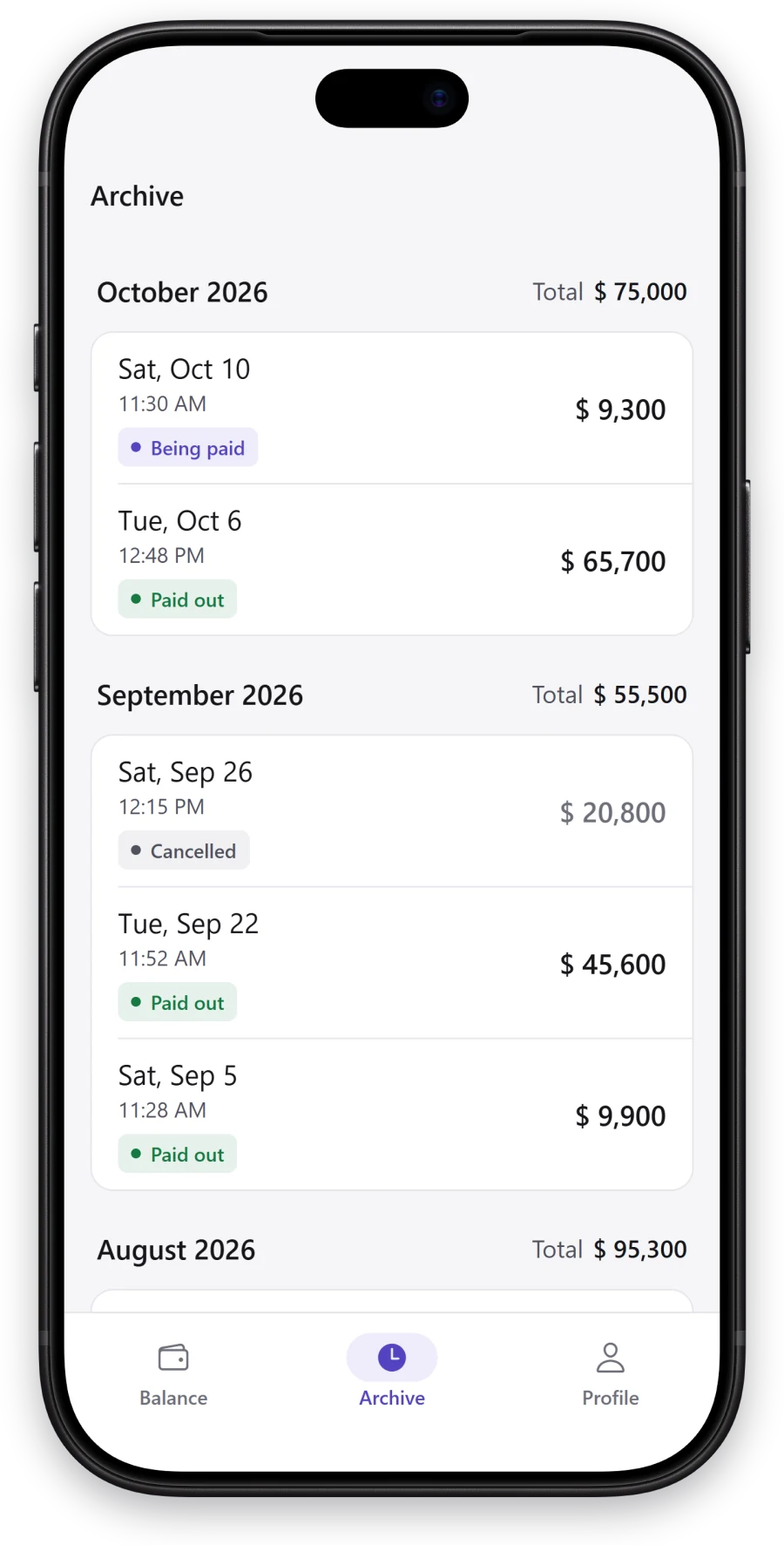
Waiters sign in to the same app and get their own view: their balance, the withdrawal in progress and everything they’ve been paid. They never see anyone else’s amounts.
screenshot of the real app on an iPhone, with demo data, translated from Spanish
Exact to the peso.
Exact to the peso.
Money that gets split has to add up. The rules live in the API, and the app and the web panel show every share before anything is closed.
Three rules the split never breaks
Fixed amounts first
A waiter can get a fixed amount before the split. Only what’s left is shared out, and the screen says how much that is.
The shares add up to the pool
Amounts are rounded with the largest-remainder method, so the shares always add up to the pool exactly. That is why one waiter gets $ 4,812 and another $ 4,813 at the same 25%.
A day can’t be split twice
Closing runs in one database transaction that locks the rows it reads, so a double tap or two phones at once can’t split the same pool twice.
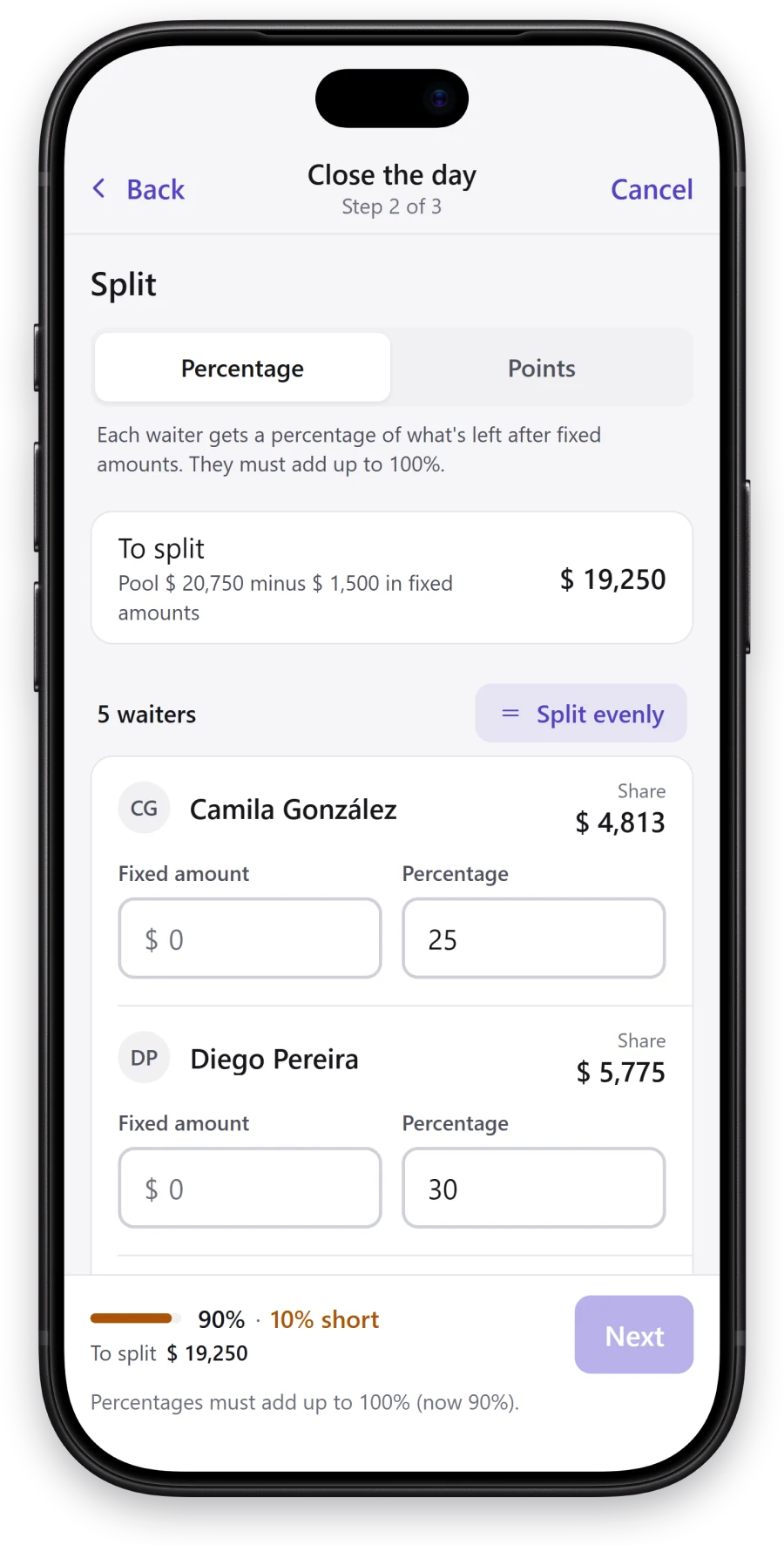
The bar under the split checks the math as you type. At 100% it turns green and says it adds up; anything else says how much is missing, and Next stays off until it’s fixed.
What it doesn’t do, on purpose
Small on purpose: it tracks and splits, and the restaurant keeps its own money.
- Hold or move money: the restaurant pays from its own bank account
- Show a waiter anyone else’s balance
- Undo a closed day
- Let a split that doesn’t add up go through
Paying out, without touching the money.
Paying out, without touching the money.
A waiter asks to withdraw from their balance, and that amount is set aside at once. When the restaurant closes the period, the pending requests become one payout with a bank-ready PDF.
The restaurant pays from its own account and ticks each person as paid, or all of them at once. A payout can be cancelled only while nobody has been paid, and then every balance goes back.
How it’s built.
How it’s built.
One API behind every screen: the restaurant’s web panel, and the same app on iOS and Android for restaurants and waiters.
- Web panel and appReact · Expo · React Native · TypeScript
- APIExpress · JWT · one check per role
- MySQLmanaged database
Closing the day
- Preview of every share
- The restaurant confirms
- One transaction, then a push to each waiter
Technical details
Three roles, checked on the server
Admin (ServiceIn staff), restaurant and waiter. The role travels in the token and every route checks it in its own middleware: 5 routes for admin, 22 for restaurants, 5 for waiters, and public ones for sign-in, password reset and the app status.
Sign-in
JWT with a 30-day expiry and the secret in the environment (the server won’t start without it), rate limits on sign-in and password reset, and a reset by a 6-digit code sent by email.
The split
Fixed amounts first, then percentage or points, rounded by largest remainder. The API does it inside one transaction with SELECT … FOR UPDATE; the app and the web panel show the shares before closing.
Payouts and PDFs
Withdrawal requests reserve the balance; closing a period groups them into a payout. The server draws the bank document and the reports with pdfkit; the web panel downloads them and the app saves and shares them.
Releases
EAS build profiles for development, preview and production, with channels of the same names, versions that increment on their own and over-the-air updates. An app-status endpoint works as a kill switch and a minimum-version check, and older app versions keep working against the new API.
A demo mode for screenshots
The new versions of the app and the web panel can answer the API’s routes from memory, with an invented restaurant and 120 days of history, so screenshots and previews never touch real data. The screens on this page come from it.
Running it since 2024.
Running it since 2024.
Live since December 2024, and on the App Store and Google Play today.
38
API endpoints, counted in the repository: 5 for admin, 22 for restaurants, 5 for waiters and 6 public.
3
Roles, each one enforced on the server: admin, restaurant and waiter.
Let’s talk.
Open to full-time roles and B2B contracts, remote or in Zagreb. I read and answer every message myself.
- Or email me directly
- hola@matidom.dev