in production2026Custom software for a window and door factory
Aberturas Blende
Aberturas Blende
A custom system for a Montevideo window manufacturer, and an AI assistant that works inside the same rules as the people using it.
I’m showing the screens in English so you can read them: their text, including the assistant’s replies, was translated from Spanish as each screenshot was taken, and nothing on screen was redrawn. Blende and its assistant run in Spanish.
- “From spreadsheet to certificate.” On mint, with “A window manufacturer in Montevideo” and the route: spreadsheet, job, delivery note, installer, month-end, document.
- “If the spreadsheet doesn’t match, it’s rejected.” In Carla Méndez’s admin session, with the full menu on the left, a new job is imported and the system reports “Imported US$ 44,737.87 and your spreadsheet declares US$ 44,737.87. It matches.”
- “Every unit, from factory to site.” The Residencial Arrayanes job, with its supply (60%) and installation (40%) bars.
- “A numbered delivery note certifies 60% by default.” The document for delivery note R-0002, for Grupo Costero, with Tomás Ríos as driver, issued by Carla Méndez.
- “Installers report from their phone.” and “Without seeing a single price.” On a phone, the report for unit A1: “How many did you install?” 2 “of 2 on site.” The installer taps “Scratched glass,” and the note reads “The fixed sash at 106 came with a scratch on the glass.”
- “Month-end: advance deduction, retainage and VAT.” In certificate C-0002 for October 2026, the 40% advance deduction and the 5% retainage are worked out on the 12,537.26 certified this period and come off the total, which includes 231.00 in extras, leaving an amount due of 7,126.49. The 22% VAT goes on the invoice, not into the amount due.
- “Screen, printer and PDF: the same document.” The C-0002 progress certificate with its Print and PDF buttons.
- It closes on “Aberturas Blende,” “in production,” 4 roles, 23 tables and over 500 tests.
The screens are screenshots of the real system with test data; their text was translated from Spanish as each one was taken.
From spreadsheet to certificate.
From spreadsheet to certificate.
Aberturas Blende manufactures, delivers and installs PVC and aluminum windows in Montevideo, and every delivery note and monthly progress certificate used to go through the owner, copied from Excel into Word. I built a system that covers that whole path, from the budget spreadsheet to the month’s certificate.
The spreadsheet only goes in if it matches
The budget is loaded from the company’s own Excel file. The importer finds its way by the text, not by cell positions, and if a section doesn’t add up to its own total, it can’t be imported.
Blende system · test data · translated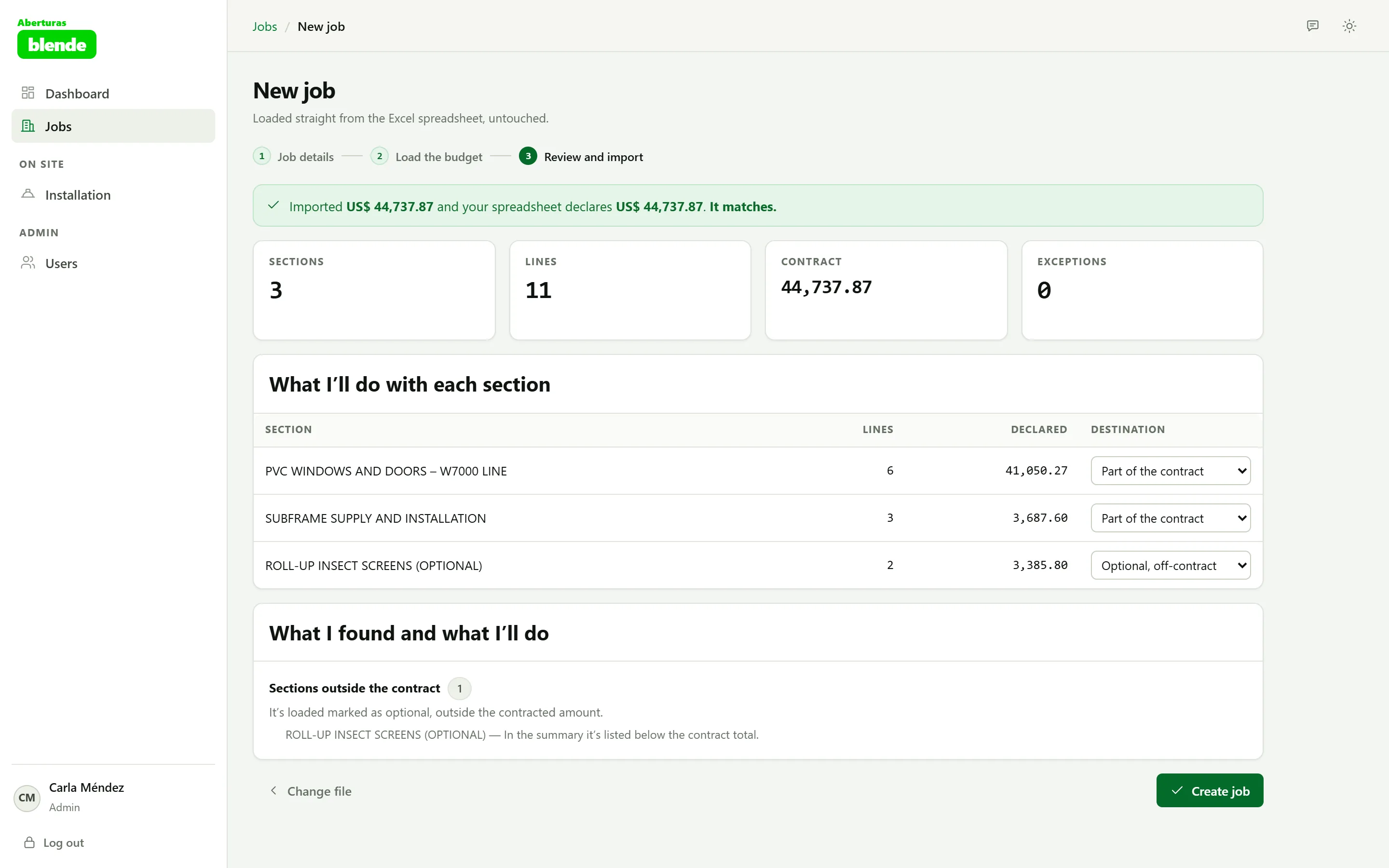
screenshot of the real system, with test data, translated from Spanish The job, unit by unit
Every window or door unit is tracked from factory to site: what was delivered, what was installed and what’s left, with the contract value and the balance on top.
Blende system · test data · translated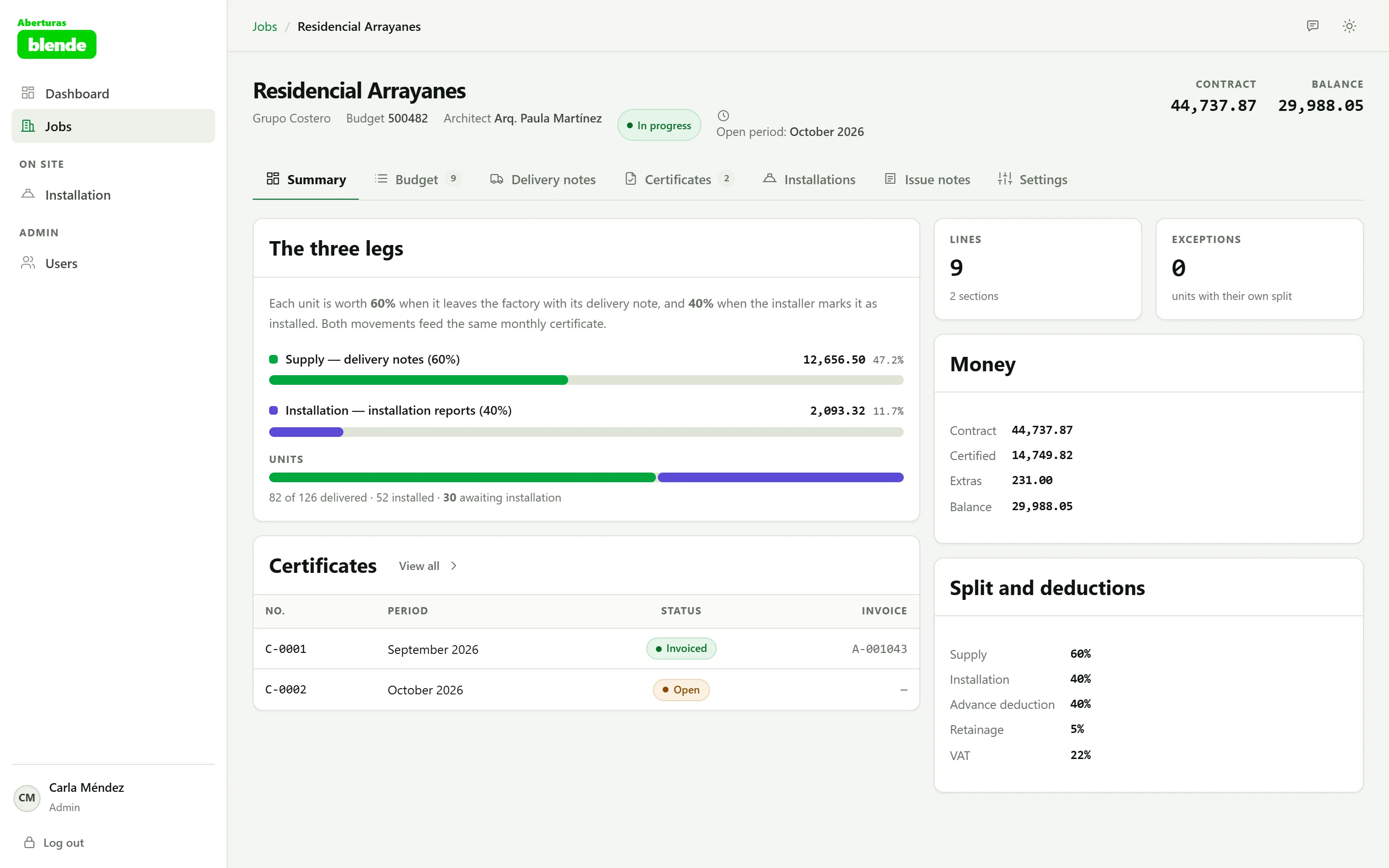
screenshot of the real system, with test data, translated from Spanish The delivery note, numbered
Each delivery note gets a number and certifies the supply stage. It won’t let you ship more than the contract says, and once issued it can only be voided.
the default split: 60% on delivery, 40% on installation
The installer, from the phone
Installers mark what they’ve put in from their phone, in the same app, and can report a problem with a photo. That certifies the installation stage, and they never see a price: the server strips it.
Blende system · test data · translated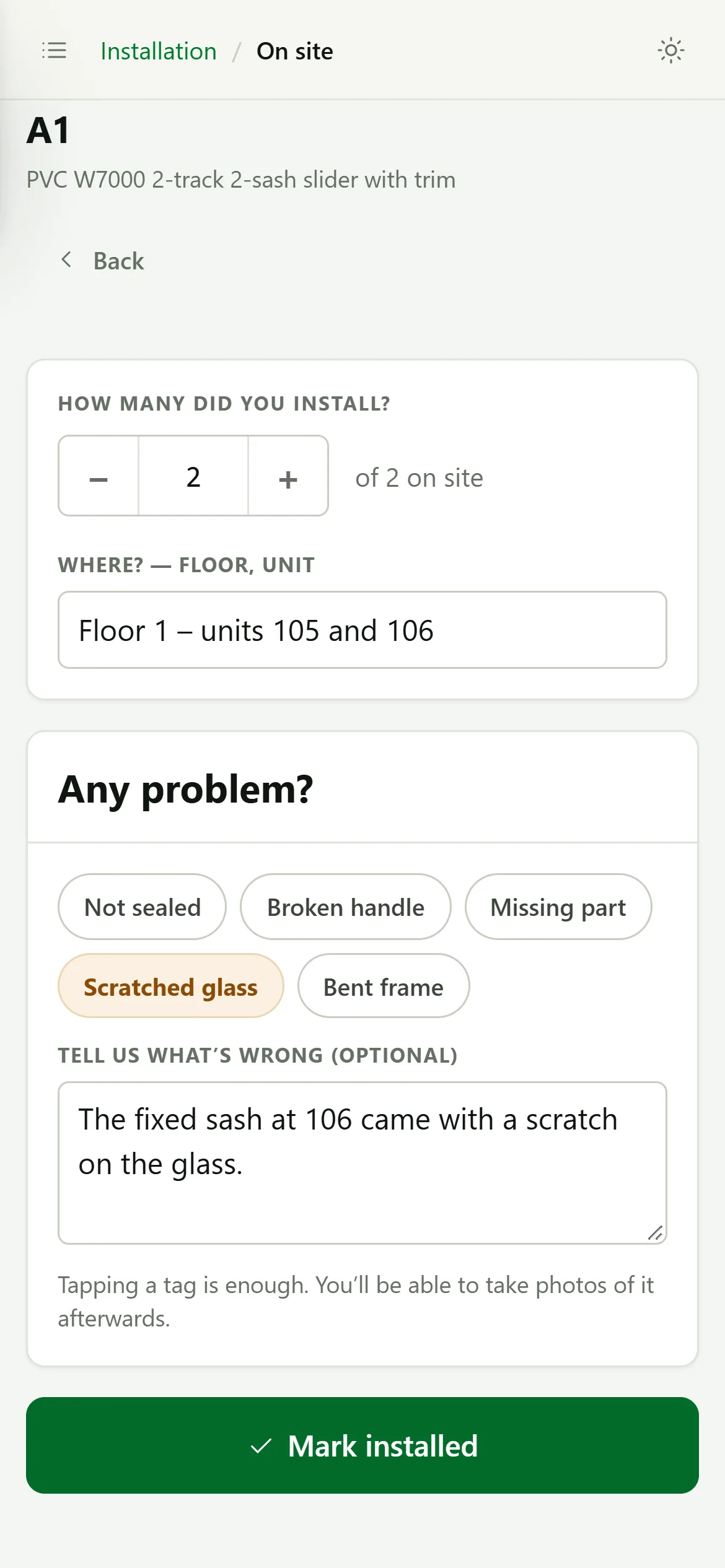
screenshot of the real system, with test data, translated from Spanish Month-end
Every delivery note and installation report lands in that month’s certificate, which takes off the advance deduction and the retainage and works out the invoice VAT separately. The PDF is printed from the same HTML you see on screen, and a test pins the math to the cent against real historical certificates.
Blende system · test data · translated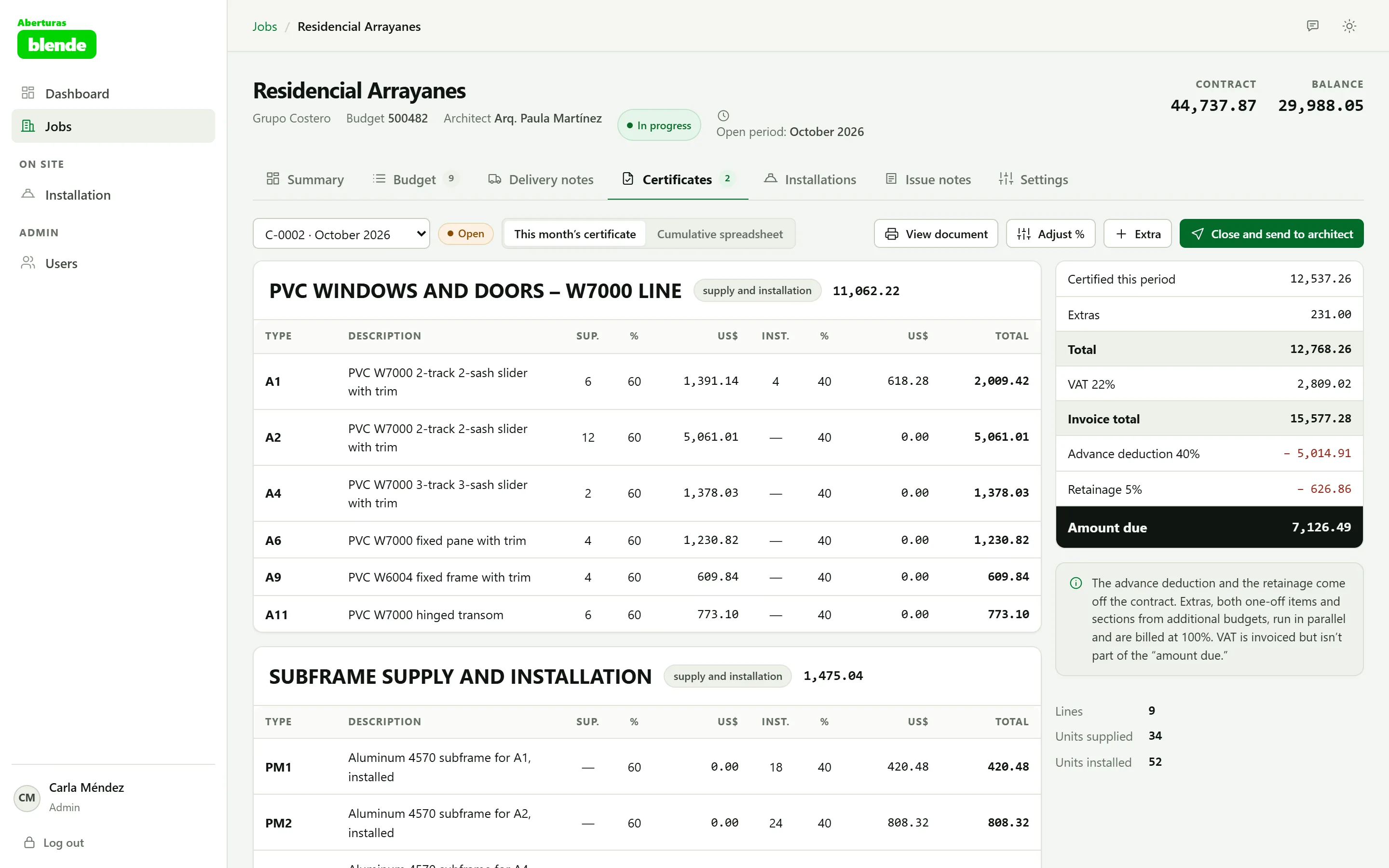
screenshot of the real system, with test data, translated from Spanish
Just ask.
Just ask.
finished and testedIn production it switches on with an API key.
In October 2026 I added an assistant: a side panel where admin, office and logistics staff ask in plain words for what used to take several screens, like “what’s left to deliver at Residencial Arrayanes?” or “make me a delivery note with 2 A6 and 1 A9.”
It’s Claude, by Anthropic, with ten tools: six that read and four that prepare a write (a delivery note, an extras delivery note, importing a budget from an .xlsx file, and a certificate adjustment). None of those four writes on its own: each one leaves a card that the same person reviews and confirms.
- “Just ask.” On violet, with “An assistant inside Blende.”
- “A panel inside the system.” On the Residencial Arrayanes job page, in Carla Méndez’s admin session with the full menu, the cursor taps the assistant button and the empty panel opens.
- “Same API, your permissions.” Asked “What’s left to deliver at Residencial Arrayanes?” the assistant shows “Searched jobs for ‘Arrayanes’” and “Checked what’s left to deliver,” then answers: “Residencial Arrayanes (Grupo Costero) still has 44 units of 126 left to deliver. 82 have been delivered, 65.08%.” A list by unit type follows.
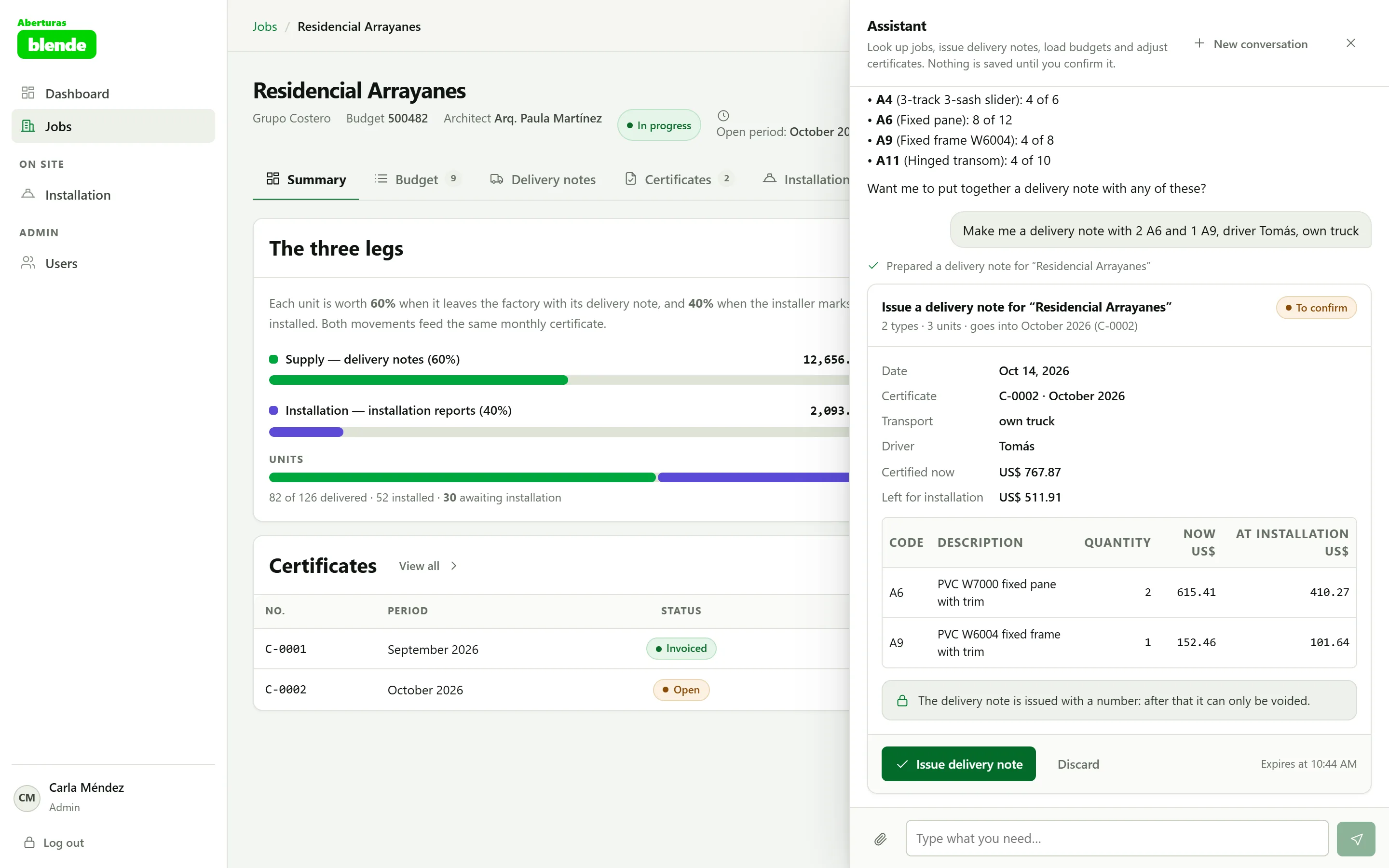
- “It drafts the delivery note, never issues it.” A card marked “To confirm” with 2 A6 and 1 A9.
- “The server builds the card, not the model.” The focus moves to “Certified now US$ 767.87.”
- “Nothing is saved until you confirm.” and “R-0004, issued exactly once.” The cursor turns yellow on “Issue delivery note,” and the card turns “Confirmed,” reading “Delivery note R-0004 issued in C-0002 · October 2026.”
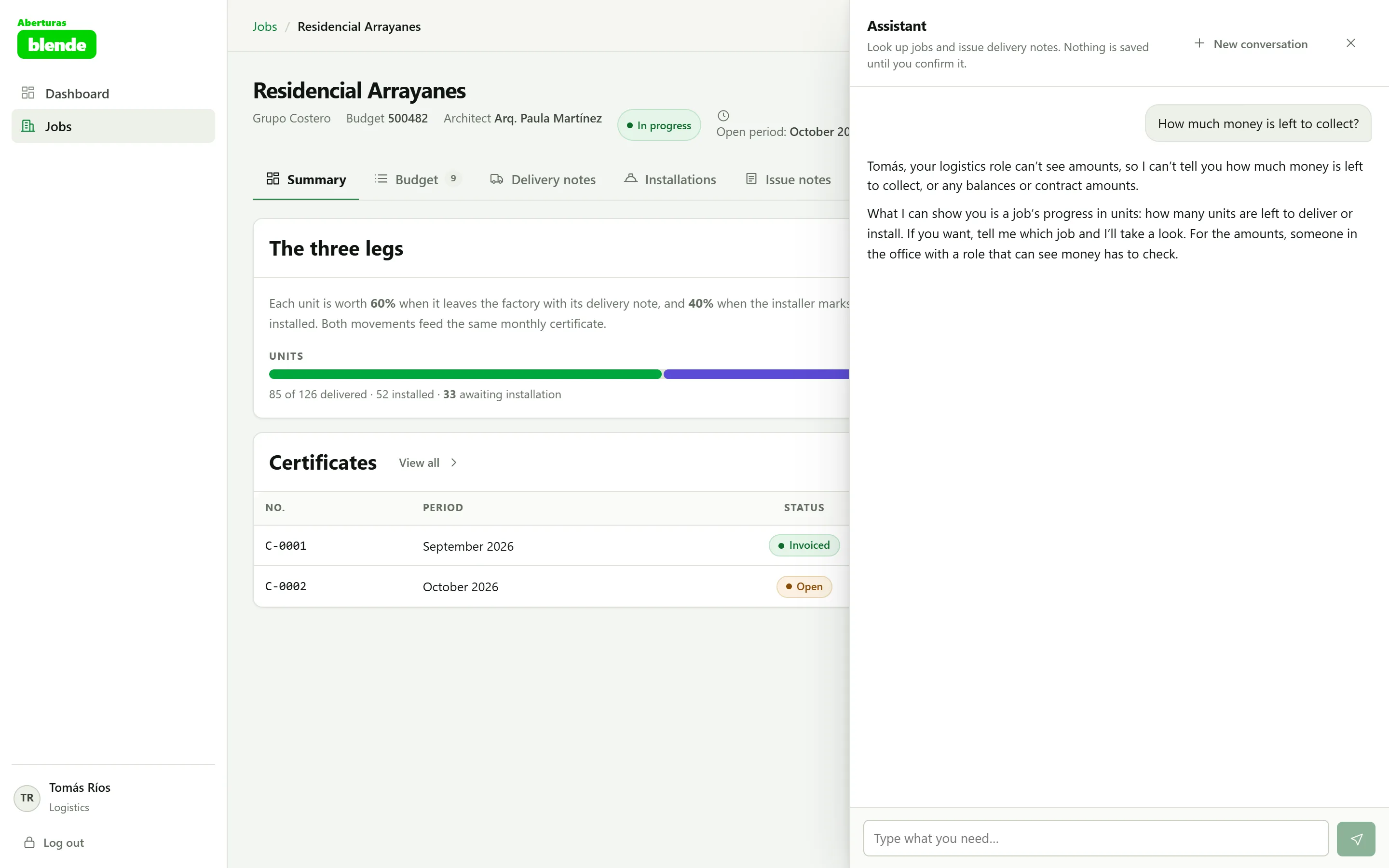
- “Logistics asks about money and gets none.” Tomás Ríos, from logistics, whose menu has only Dashboard and Jobs, asks “How much money is left to collect?” and the assistant answers: “Tomás, your logistics role can’t see amounts, so I can’t tell you how much money is left to collect, or any balances or contract amounts.” It offers progress in units instead.
- On mint, the diagram: person, assistant (Claude), tools, Blende API (your session, your permissions) and Postgres (rules in the database), with the branch proposal, you confirm, it runs, back to the API; and three pills: “Same API,” “You confirm” and “No amounts for logistics.”
- It closes on “Blende · assistant”: 10 tools (6 read, 4 propose), under 1 cent per message and over 500 tests.
The screens are screenshots of the real system with test data; their text, including the assistant’s replies, was translated from Spanish as each one was taken.
Three rules, none of them left to the model
It does what the screens do, with your permissions.
Every tool calls the same API the screens use, with the user’s own session: same permissions, same validations, same database constraints. It has no direct access to business tables, and each role is only offered the tools it may use.
Nothing is saved until you confirm.
A write becomes a proposal, and the server builds the card from API data, not from the model’s text. Only the person who asked can confirm it, within 30 minutes, exactly once, even with a double click.
Money never reaches those who can’t see it.
The API strips amounts before they reach the model: logistics asks the same question as the office and gets quantities only.
What it doesn’t do, on purpose
Anything that closes a month in front of the architect or undoes something already issued was left out: it’s done from the regular screens, and if someone asks, the assistant says where.
- Send, approve, invoice or reopen certificates
- Void or move delivery notes and installation reports
- Delete anything
- Load or fix the opening balance
- Change prices or quantities in the budget
- Log installation reports
- Manage users
How it’s built.
How it’s built.
TypeScript end to end: Fastify and PostgreSQL on the back, React on the front, and the assistant on Claude Sonnet, by Anthropic, through tool use. Business rules live in the database as constraints: 23 tables and four roles.
- Personadmin, office or logistics
- AssistantClaude
- 10 tools6 read · 4 propose
- Blende APIyour session, your permissions
- Postgresrules in the database
The 4 that propose:
- proposal
- you confirm
- it runs
Technical details
The ten tools
Admin and office get all ten; logistics gets six, with no certificates or spreadsheets.
buscar_obrasreadsFinds jobs by name or client: status, units contracted, delivered and installed, and money only if the role can see it.ver_obrareadsA job’s header, split, totals, sections, certificates and extras.ver_pendientesreadsLines with something left to deliver or install, with the totals already added up by the server.ver_remitosreadsThe latest delivery notes, up to 30: number, type, date, certificate and whether it was voided.ver_certificacionreadsA certificate’s summary (total, VAT, advance deduction, retainage and amount due) and its lines.analizar_planillareadsAnalyzes the attached .xlsx without saving anything: whether it matches, its sections and what it suggests.crear_remitoproposesDrafts a delivery note for confirmation. It doesn’t issue it.crear_remito_adicionalproposesAn extras delivery note at the price the person gave. It never makes up a price.cargar_presupuestoproposesA new job or an additional budget from the .xlsx file.ajustar_certificadoproposesThe split, progress, units or factor of a section, on an open certificate.
The loop
Each message is a turn of up to 8 model calls and about 100 seconds, without streaming: the answer arrives whole. If it didn’t finish, it says so and what was done stays saved. The system prompt and the tools go out identical on every request, so the API caches them and bills them at a fraction. There are per-person limits: 30 messages every 5 minutes.
Atomic confirmation
The proposal moves from “pending” to “executing” with a conditional UPDATE: only if it belongs to whoever confirms, is still pending and hasn’t expired. Of two simultaneous clicks, or two tabs, only one finds it pending, and the delivery note is issued once. Confirming sends what the server stored, with the confirming user’s session, so permissions are checked again.
History is never rewritten
Messages are stored as json, not jsonb, on purpose: jsonb reorders keys, and the history has to go back to the API byte for byte as the model sent it, which is what its cache looks at. If someone’s role is downgraded and they no longer see money, their conversations with amounts stop showing and their proposals can’t be confirmed.
What comes in is data
Whatever arrives in a spreadsheet or a tool result is data, never instructions. Anthropic receives a hash as the user identifier, never their email.
How it was tested.
How it was tested.
Over 500 automated tests, run from scratch with a single command: 340+ cover the system in production, and the rest the assistant, still in development.
69
try to break database rules and check they’re rejected.
98
cover the domain and the importer; one pins the numbers to the cent against real historical certificates.
over 300
test the API against Postgres, including the assistant with a fake model: which tools each role gets, that nothing is written without confirmation, the limits, and that logistics never receives amounts.
98
checks in a real browser, on desktop and phone. One logs in as an installer and checks that not a single amount shows up, on screen or in what the server sends.
With the real model
On October 13, 2026, on demo data: queries, a delivery note issued with its document, a certificate adjustment, logistics without amounts, and out-of-scope requests sent back to the screen. Five messages, eleven model calls.
USD 0.04under one cent per message
What’s missing
Automated tests check the rules, not whether Claude understands what it’s asked; I tested that by hand. Next is collecting a set of real requests and running it as an evaluation in CI.
Let’s talk.
Open to full-time roles and B2B contracts, remote or in Zagreb. I read and answer every message myself.
- Or email me directly
- hola@matidom.dev